Understanding AI-Powered Automation: Your Essential Starting Point
AI-powered automation is changing how businesses operate by combining artificial intelligence with automation to handle tasks that once required human judgment. Here’s what you need to know:
AI-powered automation fuses AI and automation to perform tasks with minimal human intervention. It learns and adapts using technologies like machine learning to handle complex, unstructured data like customer emails and conversations. Unlike traditional automation, which follows fixed rules, AI-powered automation adapts to changes and handles messy, real-world information, improving human work rather than replacing it entirely.
If you’re a local business owner drowning in customer reviews and repetitive tasks, this matters. Imagine an AI system automatically responding to customer inquiries, analyzing review sentiment, and flagging urgent issues—all before you even open your laptop.
AI-powered automation isn’t about robots taking over. It’s about giving you smarter tools that work 24/7, learn from your business patterns, and free you up to focus on what humans do best: building relationships and growing your business.
Data shows 90% of business leaders who use AI report cost and time savings. For many industries, AI-powered automation can slash labor costs by up to 30% while dramatically improving response times and customer satisfaction.
With one in four businesses adopting AI in 2024, the question isn’t if AI will impact your business, but whether you’ll leverage it before your competitors do.
What is AI-Powered Automation? The Core Concepts
At its heart, AI-powered automation is the intelligent evolution of traditional automation—think of it as automation with a brain. While traditional automation follows a script, AI-powered automation can interpret, learn, and make decisions. The fundamental difference is that automation relies on predefined rules, whereas AI brings intelligence to analyze data, identify patterns, and evolve. When combined, you get a system that not only executes tasks but also understands, adapts, and optimizes.
This intelligence is powered by several key technologies:
- Machine Learning (ML): The engine that allows AI systems to learn from data without explicit programming. ML models identify patterns and predict outcomes, refining their performance over time to get smarter as they work.
- Natural Language Processing (NLP): Allows AI to understand, interpret, and generate human language. This is crucial for reading customer reviews, responding to inquiries, or summarizing documents.
- Computer Vision: Enables AI to “see” and interpret visual information from images and videos, useful for tasks like inventory management or quality control.
These technologies converge in what we call Intelligent Automation (IA). IA connects Robotic Process Automation (RPA), which handles structured tasks, with AI and Business Process Management (BPM) to streamline end-to-end processes. This allows AI-powered automation to tackle complex, dynamic environments where data is messy or incomplete—a game-changer for local businesses dealing with varied customer feedback.
How is it different from traditional automation?
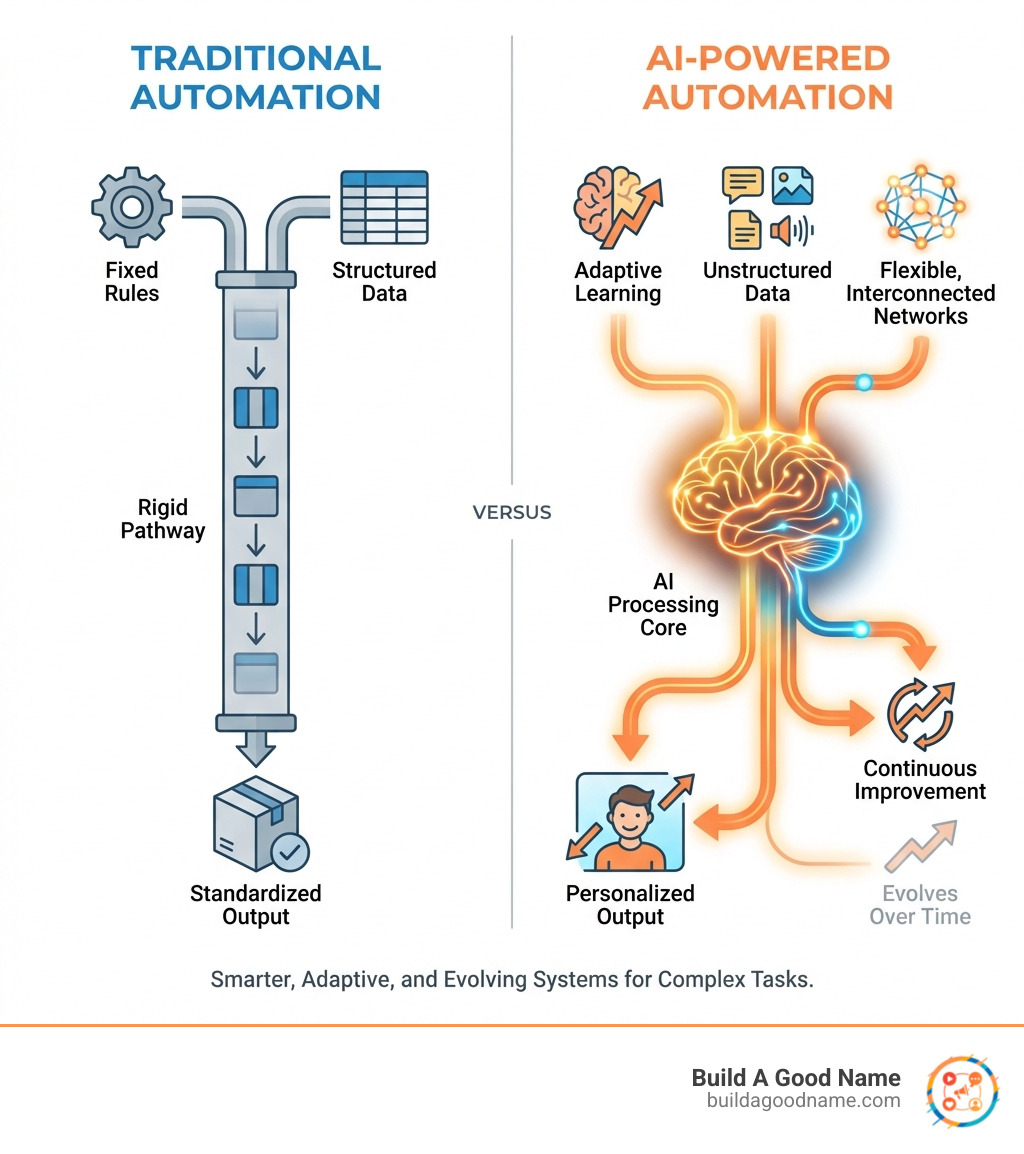
Traditional automation is like a machine following a fixed blueprint. It excels at tasks with clear rules and structured data (like spreadsheets). If a task deviates, it hits a wall.
AI-powered automation, however, is like a skilled artisan who adapts to new challenges. It thrives in dynamic environments and can process unstructured information such as text, images, and audio.
Here’s a quick comparison:
| Feature | Traditional Automation | AI-Powered Automation |
|---|---|---|
| Rules | Fixed, predefined | Learns and adapts from data |
| Data Type | Structured (databases, spreadsheets) | Unstructured (text, images, audio) |
| Flexibility | Low, struggles with variations | High, adapts to new scenarios |
| Decision-Making | Rule-based, no inference | Intelligent, inference-based |
| Learning Capability | None | Continuously learns and improves |
| Task Complexity | Simple, repetitive, predictable | Complex, dynamic, requires judgment |
The core stages of AI-powered automation
We see AI-powered automation as a continuous, closed-loop process of improvement, often described in four core stages:
- Find: The AI identifies patterns and opportunities in your data. Machine learning finds and classifies patterns in unstructured data that traditional automation can’t process, like classifying documents or identifying themes in customer feedback.
- Decide: Once patterns are found, AI combines this intelligence with business rules to make informed decisions, ensuring automated actions are accurate and aligned with your objectives.
- Act: Based on the decisions made, automated actions are executed. This can involve engaging software bots (RPA), sending automated responses, or triggering workflows.
- Optimize: The final, continuous stage. The system monitors results, learns from them, and proactively refines its processes. As Gartner notes in their Market Guide for AIOps platforms, optimizations move beyond reactive fixes to become predictive and proactive, turning new insights into improved business operations through closed-loop feedback.
How AI handles unstructured data
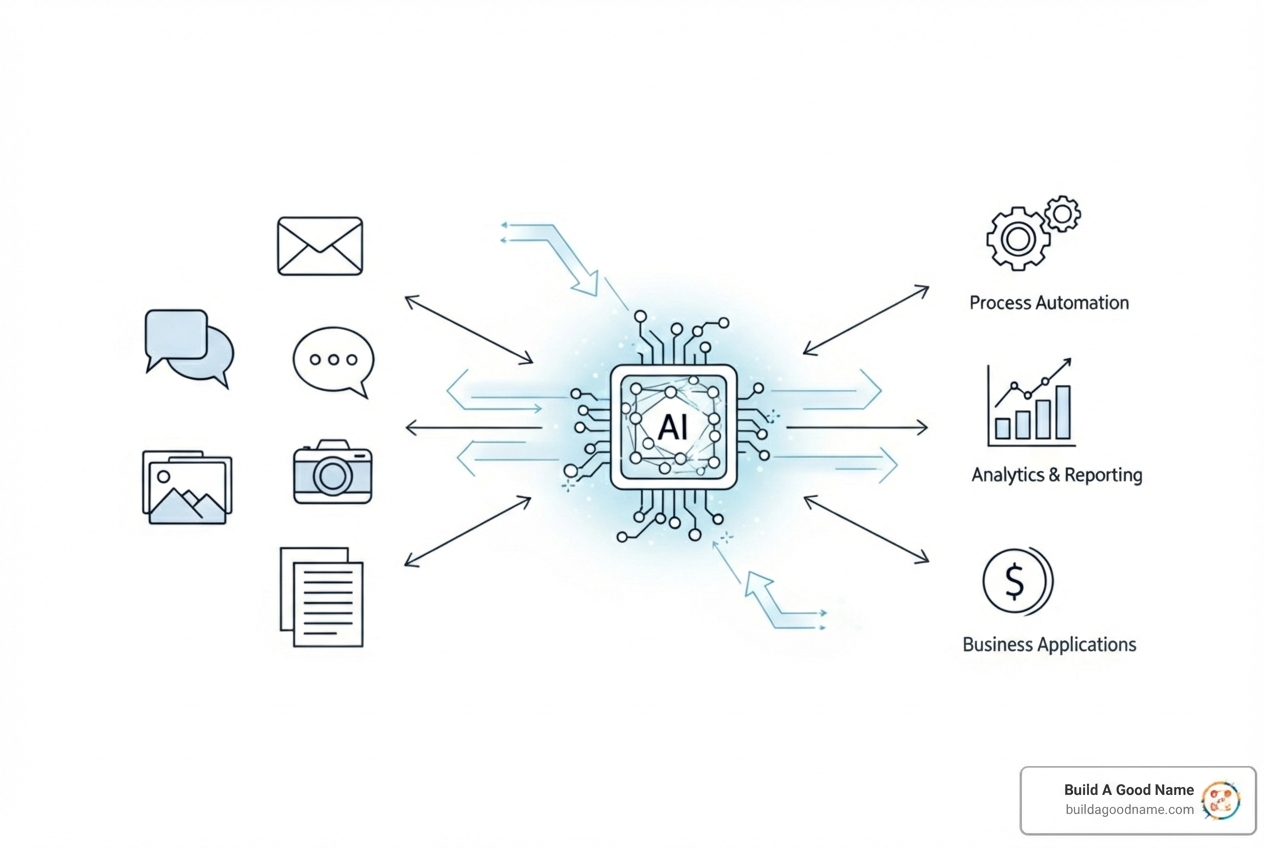
This is where AI-powered automation truly shines. Unstructured data—like text in a review, an image, or a voice message—makes up the vast majority of business information. AI can process it using:
- Text Analysis (NLP): NLP understands the meaning, sentiment, and intent behind written text. It can read customer emails, social media comments, and online reviews to categorize them and extract key information.
- Image Recognition (Computer Vision): AI can identify objects, faces, and scenes within images, helping with tasks like inventory checks.
- Speech-to-Text: This technology converts spoken language into text, allowing AI to process voice messages or customer service calls.
For a local business, this means AI-powered automation can analyze every customer interaction, automatically detect urgent issues, and suggest personalized responses, turning chaotic data into actionable insights. To learn more, check out our guide on managing customer feedback.
The Transformative Benefits for Your Business
Embracing AI-powered automation is about fundamentally changing how we operate to achieve new levels of efficiency, insight, and customer satisfaction. For local businesses, these benefits translate directly into a stronger competitive edge.

Improve productivity and reduce costs
One of the most immediate benefits of AI-powered automation is a dramatic improvement in productivity and a significant reduction in operational costs.
- 24/7 Operation: AI agents work around the clock, ensuring continuous service and processing, which is invaluable for customer service.
- Significant Cost Savings: Studies show that AI-powered automation can slash labor costs by up to 30% for several industries by automating routine tasks.
- Impressive ROI: Beyond labor costs, businesses report substantial returns. One study found a 248% ROI over three years by improving efficiency and reducing legacy system costs.
- Error Reduction: Automating tasks like data entry drastically reduces human error, leading to more accurate records and fewer costly mistakes.
- Employee Focus on Strategic Tasks: By taking over mundane tasks, AI-powered automation frees up employees to concentrate on strategic, creative, and customer-facing activities. We explore this further in our insights on AI for Business Reviews.
Improve decision-making and gain insights
AI-powered automation acts as a powerful ally, processing vast amounts of data at high speeds to uncover hidden insights.
- Advanced Data Analysis: AI can quickly process large datasets, spotting patterns and predicting trends that humans might miss.
- Predictive Analytics: By analyzing historical data, AI can predict future outcomes, such as customer behavior or market trends, allowing for proactive strategies.
- Proactive Risk Detection: AI algorithms can identify anomalies and potential risks in real-time, from fraudulent transactions to negative trends in customer feedback.
- Actionable Insights: AI-powered automation presents complex information in an understandable format, empowering data-driven decisions. As a McKinsey report on generative AI’s potential highlights, this technology has immense economic potential to drive productivity.
Lift the customer experience
In local business, customer experience is everything. AI-powered automation helps provide faster, more personalized, and consistent interactions.
- Personalization at Scale: AI can analyze individual customer preferences to deliver highly personalized experiences, from custom recommendations to custom communication.
- 24/7 Support: AI-powered chatbots and virtual agents can handle customer inquiries around the clock, resolving common issues instantly and escalating complex cases to human agents when needed.
- Faster Response Times: AI-powered automation can instantly acknowledge a customer’s message or review, dramatically reducing wait times and improving satisfaction. Our Automated Review Responses: Complete Guide dives deep into how this works.
- Consistent Service: AI ensures every customer receives consistent information and support, building trust and reinforcing your brand’s reliability.
Real-World Applications of AI Automation
AI-powered automation isn’t a futuristic concept; it’s already changing businesses of all sizes. From streamlining customer interactions to optimizing back-end operations, its applications are vast and growing, often fostering cross-departmental collaboration by connecting disparate systems.
Customer Service and Reputation Management
This is an area where AI-powered automation offers immense value for local businesses.
- AI-powered Chatbots and Virtual Assistants: These tools handle a significant percentage of incoming inquiries, providing instant answers and freeing up staff for more complex interactions.
- Ticket Routing and Prioritization: AI can analyze incoming customer requests and automatically route them to the right department, identifying urgent issues that need immediate attention.
- Automated Review Replies: For local businesses, managing online reviews is crucial. AI-powered automation can generate personalized responses to customer reviews, saving hours of manual work. This is a core offering for us, and you can learn more about AI Review Replies and how an Automated Feedback System can transform your operations.
- Sentiment Analysis: AI can analyze the tone in customer feedback, helping you quickly identify trends in positive or negative sentiment to proactively address issues.
Healthcare
While our focus is local businesses, it’s insightful to see how AI is revolutionizing other sectors. In healthcare, AI assists with early diagnosis by analyzing medical images, automates administrative tasks like scheduling, and even predicts patient deterioration in ICUs to enable proactive care.
Manufacturing and Supply Chain
These larger-scale examples show principles that apply to any business with inventory. AI is used for:
- Predictive Maintenance: By analyzing data from machinery, AI can anticipate failures before they happen, minimizing downtime. For example, BMW Group’s Regensburg plant uses AI to predict maintenance needs for its conveyor systems.
- Inventory Optimization: AI analyzes sales data and market trends to predict demand with greater accuracy, optimizing inventory levels.
- Quality Control: Computer vision can inspect products for defects with greater consistency than human eyes.
- Supplier Risk Assessment: AI can analyze global data to map supplier networks and identify vulnerabilities, a critical gap for many businesses.
Insurance and Finance
In these data-driven industries, AI-powered automation is used for claims processing, real-time fraud detection, risk assessment in underwriting, and monitoring for regulatory compliance.
Navigating the Future of Work and AI
The narrative around AI-powered automation is shifting from replacement to partnership. The future of work will be characterized by human-AI collaboration, where our roles evolve to leverage these intelligent tools.
This evolution will lead to shifting job roles. The World Economic Forum’s Future of Jobs Report 2025 predicts a net increase of 78 million new jobs by 2030, suggesting that while some tasks will be automated, new opportunities will emerge in roles requiring creativity, strategy, and human connection.
The Rise of Autonomous AI Agents
A significant advancement is the autonomous AI agent. These are sophisticated systems, not just chatbots, designed to perform complex, multi-step tasks from start to finish.
- Task Execution: Autonomous AI agents can execute tasks across various digital environments, interacting with websites and software. For instance, OpenAI’s Computer-Using Agent (CUA) model combines vision and reasoning to simulate controlling computer interfaces for users.
- Multi-step Workflows: Imagine an AI agent that can book a flight, fill out a form, or check the news on a website without direct human intervention after the initial prompt. These agents blend autonomy with generative intelligence to take action across systems.
- Computer Use by AI: This concept refers to AI systems interacting with computer interfaces just like a human would—clicking buttons, typing, and navigating applications. This dramatically expands the scope of tasks that can be automated.
The Evolving Role of Humans in an Automated World
As AI-powered automation takes on more routine tasks, the role of humans will evolve towards areas where our unique capabilities are indispensable.
- Strategic Thinking: Humans will focus on setting goals, developing strategies, and making high-level decisions that guide AI systems.
- Creativity and Innovation: True innovation and creative breakthroughs still require human ingenuity.
- Empathy and Emotional Intelligence: Customer relationships, team management, and nuanced social interactions will remain a human domain.
- AI Oversight and Governance: We will be responsible for training, monitoring, and refining AI systems, ensuring they operate ethically and effectively.
The future isn’t about replacing humans but creating a partnership where AI handles routine queries, freeing humans to address complex issues requiring empathy and critical thinking.
Key skills needed for the future
To thrive in this AI-powered automation era, we must cultivate a new set of skills:
- AI Literacy: Understanding how AI works, its capabilities, and its limitations.
- Data Analysis: The ability to interpret AI-driven insights and translate them into action.
- Critical Thinking and Problem-Solving: Tackling complex problems that AI cannot solve autonomously.
- Emotional Intelligence: For effective collaboration, leadership, and customer interaction.
- Change Management: Adapting to new technologies and guiding teams through transitions.
Implementation, Challenges, and Ethics
While the promise of AI-powered automation is immense, successful implementation requires careful planning around challenges and ethical considerations. Technological requirements can vary, but businesses generally need access to sufficient computing power, robust data infrastructure, and specialized software. The quality of your data is paramount—”bad data in, bad data out.”
Getting started with AI-powered automation
For local businesses, the path to AI-powered automation doesn’t have to be daunting.
- Identify Repetitive Tasks: Start by identifying high-volume, rule-based tasks that consume significant time but don’t require complex judgment.
- Choose the Right Tools: Select tools based on task complexity. For structured workflows, Robotic Process Automation (RPA) may suffice. For tasks needing judgment, AI-powered automation tools are essential. Low-code platforms make it easier to get started. We focus on AI for Local Businesses to make these tools accessible.
- Start with a Pilot Project: Don’t automate everything at once. Begin with a small, manageable pilot project to test outcomes and refine your approach.
- Measure ROI: Continuously track the impact of your automation efforts by measuring time savings, error reductions, and employee feedback to demonstrate value.
Key challenges and ethical considerations
As we adopt AI-powered automation, we must steer potential pitfalls responsibly.
- Data Privacy: Since AI processes vast amounts of data, ensuring compliance with privacy regulations and protecting sensitive information is critical.
- Algorithmic Bias: AI models learn from data. If that data contains historical biases, the AI can perpetuate them. Regular audits and diverse training datasets are crucial to mitigate this.
- Job Displacement: While AI is predicted to create more jobs than it displaces, some roles will change. This necessitates proactive workforce planning and retraining.
- Security Risks: Automated workflows can be targets for cyberattacks. Continuous monitoring and strict access controls are essential.
- Transparency and Explainable AI (XAI): For critical applications, we need XAI to understand why an AI made a particular decision, ensuring accountability and trust. This is vital for Reputation Management Tools where AI-generated responses must be appropriate.
Frequently Asked Questions about AI Automation
What is the difference between AI and automation?
Automation follows pre-set rules to perform repetitive tasks. It’s like a highly efficient robot following a precise script. AI, on the other hand, simulates human intelligence to learn, adapt, and make decisions based on data and experience. It’s the “brain” that can understand context and infer. AI-powered automation combines both, allowing automation to handle more complex and dynamic tasks that require judgment, learning, and adaptability, moving beyond simple rule-following.
What is a simple example of AI automation?
An AI-powered chatbot in customer service is a great example. Unlike a basic bot that follows a script (traditional automation), an AI chatbot uses Natural Language Processing (NLP) to understand a customer’s intent, access information, and provide a relevant, conversational response, learning from each interaction. If a customer asks “Where’s my order?”, a traditional bot might only respond if the exact phrase is used. An AI chatbot can understand variations like “Status of my delivery?” or “When will my package arrive?”, then intelligently retrieve and provide the correct information.
What are the main benefits of AI automation?
The primary benefits are increased efficiency, significant cost and time savings, reduced human error, and the ability to scale operations quickly. By automating routine tasks, we free up employees from repetitive work to focus on more strategic, creative, and high-value tasks that require uniquely human skills. This leads to improved productivity, better decision-making through data insights, and a greatly improved customer experience through faster, more personalized interactions.
Conclusion
AI-powered automation is not just a technological trend; it’s a fundamental shift in how businesses can operate, innovate, and grow. We’ve seen how it differs from traditional automation by its ability to learn, adapt, and handle unstructured data, making it suitable for a far wider range of tasks. The core stages of find, decide, act, and optimize illustrate its continuous, self-improving nature.
The benefits are clear and compelling: increased productivity, significant cost reductions (up to 30% in labor costs for some industries), improved decision-making through data-driven insights, and a dramatically improved customer experience through personalization and 24/7 support. From automating review replies for local businesses to predictive maintenance in manufacturing, AI-powered automation is creating real-world impact.
The future of work is undeniably collaborative, with AI agents handling routine and complex tasks, while humans focus on strategic thinking, creativity, and empathy. This means investing in AI literacy and developing new skills will be crucial for success.
While challenges like data privacy, algorithmic bias, and security require careful consideration, by starting small, choosing the right tools, and maintaining human oversight, we can implement AI-powered automation responsibly and effectively.
For local businesses, this isn’t just about efficiency; it’s about gaining a strategic advantage in a competitive market. At Build A Good Name, we empower local businesses to leverage AI-powered automation for superior Review Management Software, ensuring your online reputation is stellar, your customer interactions are streamlined, and your team is free to focus on growth.
Don’t let the complexity deter you. The time to accept AI-powered automation is now. Take the next step and learn how to implement your own automated system with our complete guide.