Why Your Online Credibility is Your Most Valuable Business Asset
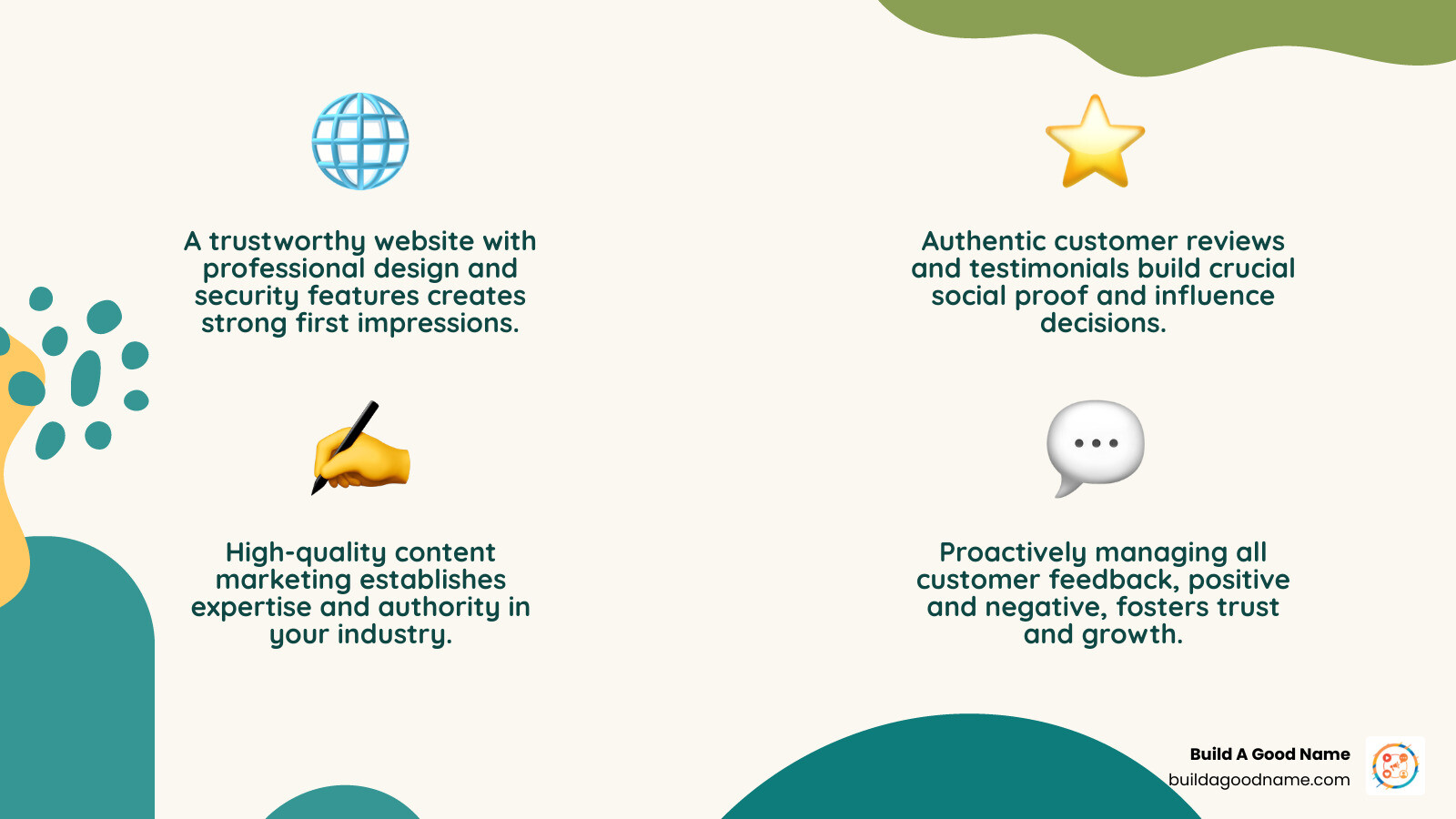
Boost online credibility by focusing on four essential pillars: building a trustworthy website with professional design and security features, collecting and showcasing authentic customer reviews, creating high-quality content that demonstrates expertise, and responding promptly to all customer feedback—both positive and negative.
Quick Actions to Improve Your Online Reputation:
- Secure your website with an SSL certificate (HTTPS)
- Claim and optimize your Google Business Profile
- Request reviews from satisfied customers via email or QR codes
- Display contact information prominently on every page
- Respond to all reviews within 48 hours
- Create an About Us page with real team photos
- Publish fresh content regularly to demonstrate expertise
Here’s a sobering reality: 84% of business executives believe consumers highly trust their brand, while only 27% of consumers actually do. That’s a massive trust gap.
Your online credibility isn’t just about looking good—it’s about survival. When 93% of consumers check online reviews before making a purchase decision, and 89% of shoppers won’t even consider a business without researching it online first, your digital reputation directly impacts your bottom line.
Think about it from your customer’s perspective. They’re searching for “best plumber near me” or “trusted dentist in Lake Elsinore.” They find your business, but your website looks outdated, you have no reviews, and your contact information is buried. What do they do? They click on your competitor instead.
The good news? Building online credibility isn’t rocket science. It’s about consistent action across a few key areas: making your website trustworthy, collecting and showcasing real customer feedback, demonstrating your expertise through content, and engaging with customers authentically.
For busy local business owners like you, this might sound overwhelming. You’re already juggling daily operations, managing employees, and serving customers. Who has time to monitor reviews across multiple platforms, respond to feedback, and maintain a content strategy?
That’s exactly why having a systematic approach matters. Small, consistent actions—like responding to reviews within 48 hours or updating your Google Business Profile weekly—compound into significant credibility gains over time.
The Foundation: Building a Trustworthy Website
Your website is often the very first handshake you extend to potential customers. It’s where they form their initial impressions, decide if you’re legitimate, and ultimately, whether they want to do business with you. To boost online credibility, we need to ensure this digital storefront is rock-solid.
First Impressions: The Power of Professional Web Design and UX
We all know that first impressions matter, and nowhere is this truer than online. Studies show that web design is responsible for a staggering 94% of first impressions, and 75% of website visitors believe a site is more trustworthy if it looks good. Think about it: how quickly do you judge a website? A study by Taylor and Francis Online suggests it takes less than a second to form an opinion. If visitors get a good impression, they’ll browse; if not, they’re gone.
So, what makes a good first impression? It’s a combination of visual appeal and seamless functionality, often referred to as User Experience (UX).
- Professional, Cohesive Design: Your website should look modern and reflect your brand’s personality. This means harmonizing fonts, complementary color palettes, and layouts that suit your business needs. A professional design, even for a local business in Lake Elsinore, signals attention to detail and professionalism.
- Mobile Responsiveness: With so many people browsing on their phones, your website must look and function perfectly on any device. If it’s clunky on a smartphone, you’re losing potential customers.
- Fast Site Speeds: We live in an instant gratification world. Slow-loading pages are a credibility killer. Visitors won’t wait around, and search engines penalize sluggish sites. We need to avoid slow site speeds to keep users engaged and happy.
- Clear Navigation: Can visitors easily find what they’re looking for? Intuitive menus, well-organized content, and clear calls to action guide users effortlessly.
- High-Quality Imagery: Blurry, pixelated, or outdated images scream “unprofessional.” Invest in high-resolution, relevant photos that showcase your products, services, or team. As the saying goes, a picture is worth a thousand words, and quality images significantly impact perceived credibility.

Essential Trust Signals to Boost Online Credibility
Beyond aesthetics, certain technical and visual cues actively tell visitors, “Hey, you can trust us!” These are often called trust signals, and they’re vital for any business looking to boost online credibility.
One of the most fundamental trust signals is an SSL certificate. You’ve seen it: the “https” prefix and the little lock icon in your browser’s address bar. The extra “s” indicates a secure connection, ensuring that any information exchanged between your website and your visitors (like contact details or payment info) is encrypted and safe. Customers feel much better knowing their information is secure, which naturally helps us build trust. Many web hosts offer free SSL certificates, making it an easy win for your credibility. For any e-commerce business, PCI compliance even requires an SSL certificate.
Then there are security seals and trust badges. These are accreditations from recognized entities like the Better Business Bureau (BBB), McAfee, Norton, Verisign, or PayPal. When visitors see these familiar logos, they instantly associate your site with a stamp of approval, signaling that you meet certain criteria for security or business practices. Displaying these prominently, especially near forms or checkout, can significantly boost conversions.
Don’t forget to showcase any awards or certifications your business has earned. These aren’t just for your office wall; they’re powerful external validations of your expertise and quality. Whether it’s a local business award or an industry-specific certification, these signals tell potential customers that you’re recognized for excellence. We’ve seen how Building Business Credibility often starts with these foundational elements.
Transparency is Key: Providing Clear and Accessible Information
Imagine walking into a store and not being able to find anyone to help you, or any signs with operating hours. Frustrating, right? The same applies online. Transparency is a cornerstone of trust, and we need to make it easy for customers to find crucial information about us.
- Contact Information: This is non-negotiable. A recent HubSpot study found that 62% of consumers think contact information is the most important element on a website. We need to make sure our street address, phone number, and email are easily findable, usually in the footer, header, and on a dedicated Contact Us page. A physical address and phone number imply that we’re a real, reachable company, which instantly builds confidence.
- About Us Page: This is our chance to tell our story! Investing time in creating an About page for your business allows us to introduce the real people behind the brand. Share our mission, our history, and even photos of our team. Humanizing our business helps customers connect with us on a deeper level.
- Privacy Policy and Terms of Use: These might seem like dry legal documents, but they are crucial for transparency. Our privacy policy explains what we do with customer data and how we protect their details. This is non-negotiable, especially since 81% of people believe the way a company treats their personal data indicates how it views them as a customer. Clear and accessible links to these policies demonstrate our commitment to ethical practices and respect for customer privacy.
Making our business information and contact details easily findable not only helps us get in the good graces of site visitors but also helps Google, as clear information on who is responsible for our website is a key criterion in Google’s Search Quality Rater Guidelines.
The Amplifier: Mastering Reviews and Social Proof
Once our website lays a solid foundation of trust, the next step is to amplify our message through the powerful voices of our customers. Reviews and testimonials are the ultimate form of social proof, helping us to boost online credibility significantly.
How to Collect and Leverage Customer Reviews
We live in an age where 89% of consumers check online reviews as part of their shopping journey, and 93% rely on them before making a purchase decision. These aren’t just numbers; they represent millions of potential customers actively seeking external validation. Social proof, as we know, has been around since the dawn of marketing, and it has only grown more valuable with the infinite purchasing options available today.
- Why Reviews Matter: Reviews are assessments of our products or services, often shared online. They offer an objective view, highlighting both strengths and areas for improvement. Testimonials, on the other hand, are personal statements from satisfied customers, serving as direct endorsements. Both are invaluable. They build trust, act as powerful social proof, help customers make informed decisions, and can even improve our search engine rankings.
- Strategies for Collection: The first step is to make it incredibly easy for our customers to leave feedback. We can do this by:
- Email Requests: Following up with customers after a purchase or service with a polite email asking for their thoughts.
- QR Codes: Placing QR codes on receipts, in-store signage, or product packaging that link directly to our preferred review platforms.
- Direct Links: Providing direct links to review sites on our website or in our email signatures.
- Leveraging Key Platforms: We need to be where our customers are. For local businesses in Lake Elsinore, these platforms are crucial:
- Google My Business: Indispensable for local visibility. Google reviews impact search rankings and are often the first point of reference.
- Yelp: Especially pertinent for service industries, where potential customers seek authentic experiences.
- TripAdvisor: A colossal pillar for travel and hospitality.
- Facebook: Blends social engagement with feedback collection.
By actively encouraging satisfied patrons to leave reviews on these platforms, we can significantly Build Customer Trust and improve our online reputation.
Best Practices for Displaying Testimonials and Reviews
Collecting reviews is only half the battle; displaying them effectively is how we maximize their impact and truly boost online credibility.
- Dedicated Reviews Page: Create a specific section on our website just for testimonials and reviews. This shows transparency and makes it easy for visitors to see what others are saying.
- Website Widgets: Many review platforms offer widgets that can be embedded directly onto our homepage or product pages, displaying a live feed of our latest reviews and ratings.
- Case Studies: For more complex services, detailed case studies that walk through a customer’s problem, our solution, and the positive outcome can be incredibly persuasive.
- Authentic Visuals: This is huge. While stock photography has its place, it can also dilute trust. Research shows that a real picture of a client performs 35% better than a stock photo portrait. We should include customer images or even videos alongside their reviews. The “picture superiority effect” means people are more likely to remember concepts through pictures than words. If we use authentic photos of our customers, our products, or our team, it instantly feels more genuine and trustworthy.
- Video Testimonials: Nothing builds trust quite like seeing and hearing a happy customer share their experience firsthand. Video testimonials are dynamic, highly engaging, and incredibly effective at conveying authenticity.
We should ensure our reviews are organized, interactive (perhaps with social media sharing options), and prominently featured to let our customers’ positive experiences speak volumes for our brand.

The Authority Builder: Content, SEO, and Social Media
Beyond a solid website and glowing reviews, we can further boost online credibility by establishing ourselves as experts in our field and engaging authentically with our community. This is where content marketing, SEO, and social media come into play.
Establish Expertise with High-Quality Content Marketing
Content marketing, particularly through blogging, is how we demonstrate our knowledge, provide value, and build authority. When we consistently publish helpful, relevant, and accurate content, we signal to both our audience and search engines that we are a trusted source of information.
- Building Authority: Think of our blog as our digital soapbox. By sharing insights, tips, and solutions related to our industry, we establish ourselves as thought leaders. This isn’t just about selling; it’s about educating and empowering our customers. For local businesses in Lake Elsinore, this could mean blog posts about local market trends, community events, or expert advice custom to our community’s needs.
- Fresh Content is Key: The written content on our website plays a big role in first impressions. According to the 2023 Trust in Marketing Index, 33% of people say stale or outdated content on a website takes a toll on their trust in that brand. Regularly auditing our website to ensure facts, statistics, and links are accurate and high-quality is a low-hanging fruit for credibility.
- Google’s E-E-A-T: Google’s Search Quality Rater Guidelines emphasize E-E-A-T: Experience, Expertise, Authoritativeness, and Trustworthiness. By creating content that genuinely demonstrates these qualities, we not only help our audience but also improve our standing with search engines. High-quality content contributes directly to our website authority, which is how trustworthy and credible search engines perceive our site to be. If we want to appear more prominently in both traditional and AI search results, building our website’s authority is crucial.
Using Social Media to Humanize Your Brand and Engage Customers
Social media is no longer just a place for sharing cat videos; it’s a powerful tool to boost online credibility by humanizing our brand and fostering direct engagement with our audience.
- Customer Service Channel: Two 2017 consumer satisfaction studies conducted by J.D. Power suggested that social media is now consumers’ preferred channel for customer service. This means customers expect us to be there, ready to answer questions, troubleshoot issues, and listen to feedback. Gartner found that failure to respond via social media can lead to a 15% increase in churn rate for existing customers. Prompt, thoughtful responses show we value our customers and are committed to service.
- Brand Personality: Social media allows us to let our brand’s personality shine through. We can use relatable language, share behind-the-scenes glimpses, and engage in conversations that go beyond pure sales. It’s easier for people to trust other people than faceless companies. By speaking in our audience’s language, we can demonstrate expertise and credibility while maintaining a friendly, human tone.
- User-Generated Content (UGC): Encourage customers to share their experiences with our brand on social media. Resharing their posts, photos, and stories acts as authentic social proof and builds a vibrant community around our business. It’s a fantastic way to showcase real customer interactions and further Online Presence and Smart Reputation Management Practices.
How to Boost Online Credibility by Managing Feedback Proactively
Even with the best products and services, feedback, both positive and negative, is inevitable. How we handle this feedback is a critical factor in whether we boost online credibility or damage it. Proactive reputation management is about turning every interaction into an opportunity to build trust.
The Art of Responding to Positive and Negative Reviews
Our responsiveness to reviews tells customers a lot about our commitment to them. It shows we’re listening, we care, and we’re engaged.
- Acknowledging Positive Feedback: When a customer leaves a glowing review, a simple “thank you” goes a long way. We should express our gratitude, perhaps mention something specific they enjoyed, and invite them back. This reinforces their positive experience and shows future customers that we appreciate our patrons. Responding to each customer review shows that feedback is taken seriously and helps build trust.
- A Framework for Responding to Negative Reviews: Negative reviews can sting, but they are also incredible opportunities. Businesses can overcome negative feedback by acknowledging its value for insights. Promptly responding to negative reviews, ideally within 48 hours, is crucial. Our strategy should involve:
- Acknowledging the Issue: Validate the customer’s feelings and show empathy.
- Apologizing (if appropriate): Even if we don’t agree with the complaint, we can apologize for their negative experience.
- Offering a Solution Offline: We should always try to move the conversation offline to resolve the specific issue. Provide an email or phone number and ask them to contact us directly. This demonstrates our commitment to making things right without airing dirty laundry publicly.
Responding thoughtfully to all reviews, both positive and negative, is a key part of Mastering Reputation Management to Enhance Brand Image and building trust and loyalty. It demonstrates our commitment to excellence and customer satisfaction.
Turning Negative Feedback into a Catalyst for Growth
It’s easy to dread negative feedback, but smart businesses view criticism as a valuable gift. It’s an opportunity to grow, evolve, and ultimately, to further boost online credibility.
- Viewing Criticism as Insight: Every negative review, even the harsh ones, contains valuable data. It’s a direct window into potential operational weaknesses, service gaps, or product shortcomings that we might not have otherwise noticed. Businesses can overcome negative feedback by acknowledging its value for insights, identifying areas for improvement, addressing grievances promptly, and empowering our team to turn feedback into action.
- Improving Products or Services: By analyzing patterns in negative reviews, we can identify recurring issues and implement changes to our products or services. This not only resolves current complaints but prevents future ones, leading to a better customer experience overall.
- Demonstrating Commitment to Customer Satisfaction: How we handle negative feedback publicly speaks volumes. By responding professionally, taking responsibility, and showing a genuine desire to resolve issues, we demonstrate our commitment to customer satisfaction. This can turn a disgruntled customer into a loyal advocate, and show prospective customers that we stand behind our work.
- Rebuilding Trust: Turning criticism into catalysts for quality affirms our brand’s journey toward greatness. Successfully resolving a negative experience can actually build stronger trust than if the issue had never occurred. It shows resilience and a dedication to excellence, which are powerful credibility boosters. This is why The Importance of Reputation Management in Customer Trust cannot be overstated.
Frequently Asked Questions about Online Credibility
How long does it take to build a strong online reputation?
Building a strong online reputation and establishing trust is an ongoing process, not a one-time project. While you might see initial results and improvements in customer sentiment within a few months of consistent effort, true credibility is built over years of reliable service, authentic engagement, and proactive management. Consistency is absolutely key. Think of it as tending a garden – it requires continuous care, watering, and weeding to flourish.
Can I just delete negative reviews?
Generally, no. Trying to delete negative reviews, especially legitimate ones, can severely backfire and erode trust. Most reputable review platforms have strict policies against review manipulation. If customers find you’re deleting honest feedback, it will make them question your integrity even more. Instead of deleting, our best approach is to respond professionally, offer solutions, and learn from the criticism. Some platforms may remove reviews that are clearly fake, spam, or violate their terms of service, but this is different from removing a genuine, albeit negative, customer experience.
What is the single most important factor to boost online credibility?
There isn’t one single “magic bullet” factor. Online credibility is a mosaic built from many pieces. However, if we had to pinpoint an overarching theme, it would be authenticity and transparency. Customers today are savvy; they can spot insincerity a mile away. Being genuine in our interactions, transparent about our business practices, and authentic in our content lays the groundwork for all other credibility-building efforts. That said, customer reviews are undeniably one of the most influential components, as 93% of consumers rely on them. They are tangible proof of our authenticity.
Conclusion: Your Journey to a Trusted Online Brand
Becoming a trusted online brand doesn’t happen overnight, but it’s an incredibly rewarding journey. We’ve explored the key pillars to boost online credibility: establishing a solid website foundation with professional design and essential trust signals, amplifying our message through authentic customer reviews and testimonials, building authority with high-quality content and strategic SEO, and proactively managing all customer feedback.
Every interaction, every piece of content, and every review contributes to our digital footprint. By consistently focusing on these areas, we can bridge the trust gap, attract more customers, and solidify our reputation as a business that genuinely cares. Enhancing your online reputation is rewarding and sustainable growth.
For local businesses in Lake Elsinore and beyond, navigating the complexities of online reputation management can be a challenge. That’s where we come in. Our AI-powered review management software is designed to help businesses like yours collect, manage, and showcase customer reviews effortlessly. We streamline the process, allowing you to highlight positive feedback and respond to all reviews with automated, personalized replies, freeing you up to focus on what you do best: serving your customers.
Ready to take control of your online story and transform your business into a trusted online brand? Let’s work together to make your name synonymous with reliability and excellence. Get started with our review management software today and begin your journey from zero to hero.