
Why Better Customer Engagement Is Your Secret Weapon for Business Growth
Better customer engagement is the ongoing process of building meaningful relationships with your customers across every touchpoint—from their first visit to your website to their post-purchase follow-up. Here’s what you need to know:
Quick Answer: The 5 Pillars of Better Customer Engagement
- Personalization – Tailor every interaction to individual customer needs and preferences
- Omnichannel Communication – Meet customers where they are (social media, email, text, in-person)
- Proactive Outreach – Don’t wait for problems; reach out first with value
- Active Listening – Solicit and act on customer feedback consistently
- Community Building – Create spaces for customers to connect with your brand and each other
Here’s the reality: 33% of customers will switch to a competitor after just one bad experience. That’s how fragile loyalty is today.
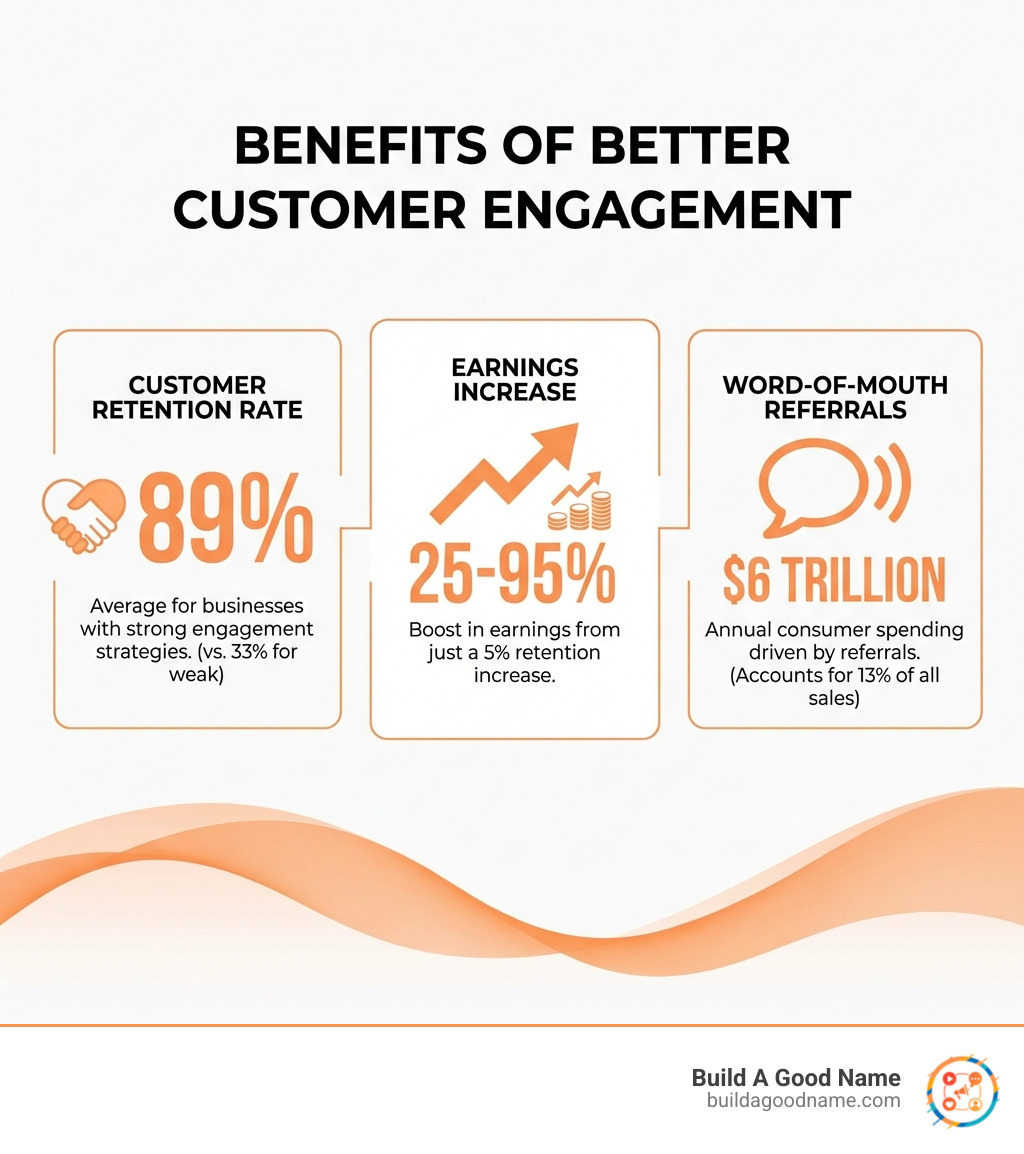
But here’s the good news: businesses with strong customer engagement strategies retain an average of 89% of their customers, compared to just 33% for those with weak engagement. That’s not a small difference—that’s the difference between thriving and barely surviving.
Customer engagement goes way beyond just making a sale. It’s about creating experiences that make people want to come back, tell their friends, and become advocates for your brand. When done right, it can increase your revenue by 25% to 95% just by boosting retention rates by 5%.
For busy local business owners, this matters even more. You’re competing against bigger brands with deeper pockets, so building genuine relationships with your customers isn’t just nice to have—it’s essential. Word-of-mouth referrals drive $6 trillion in annual consumer spending and account for 13% of all sales. Your engaged customers become your best marketing team.
The truth is simple: in today’s experience economy, customer experience is the #1 reason people choose to do business with a company. Not your prices. Not even your product features. The experience.
What is Customer Engagement and Why is It Crucial for Business Success?
At its core, customer engagement is the active participation and interaction between a customer and your brand. It’s not just about them buying something from us; it’s about the time, energy, and effort they invest in our brand, reflecting their loyalty and connection. This goes beyond mere transactions to build a lasting relationship.
Why does this matter so much for businesses, especially local ones in places like Lake Elsinore? Because strong customer engagement is a strategic lever that directly impacts our bottom line and long-term viability. It’s the difference between a one-time purchase and a lifelong customer.
Here’s a breakdown of the key benefits we gain from fostering better customer engagement:
- Increased Customer Loyalty and Retention: Engaged customers feel valued and understood. This emotional connection makes them far less likely to churn. Businesses with strong engagement strategies see vastly higher retention rates. When customers feel heard and appreciated, they stick around.
- Boosted Revenue and Customer Lifetime Value (CLV): Loyal, engaged customers don’t just stay; they spend more. They’re more open to trying new products or services, making repeat purchases, and even upgrading their existing ones. Studies show that improving customer engagement can increase cross-sell revenue by 22%, up-sell revenue by 38%, and order size by a whopping 5% to 85%. That’s a serious financial incentive!
- Improved Brand Advocacy and Word-of-Mouth Marketing: Happy customers are our best marketers. They become brand ambassadors, sharing their positive experiences with friends, family, and on social media. We know that 88% of consumers most trust referrals from people they know, making this a powerful, organic growth engine for any local business.
- Valuable Customer Insights and Innovation: Engaged customers are more likely to provide feedback, whether through surveys, reviews, or direct interactions. This feedback is pure gold, helping us understand their needs, preferences, and even pain points. This insight can fuel product development, service improvements, and help us tailor our offerings more precisely.
- Improved Customer Satisfaction and Net Promoter Score (NPS): When customers are engaged, they naturally feel more satisfied. They know we care, and that translates into higher satisfaction scores and a greater likelihood they’ll recommend us to others.
How Does Customer Engagement Differ from Customer Experience and Customer Satisfaction?
While often used interchangeably, customer engagement, customer experience (CX), and customer satisfaction (CSAT) are distinct but interconnected concepts. Think of them as different facets of the customer relationship:
- Customer Satisfaction (CSAT): This is a snapshot measuring how happy a customer is with a specific interaction or product. Was their support issue resolved? It’s typically measured with surveys asking, “How satisfied are you?”
- Customer Experience (CX): This encompasses the entire journey a customer has with a brand, from awareness to post-purchase. It’s the sum of all interactions and perceptions. A great CX means every touchpoint is smooth and positive. Recent industry reports highlight that 73% of customers would switch to a competitor after multiple bad experiences, underscoring CX’s importance.
- Customer Engagement: This is the active participation and ongoing relationship between a customer and a brand. It’s not just about what we do for them (CX) or how they feel in a moment (CSAT), but how they interact with us—following on social media, joining a loyalty program, or providing feedback. It’s the effort to foster a two-way conversation.
In short: A customer can be satisfied with a purchase (CSAT) and have a good journey (CX), but still not be engaged. The goal is to achieve all three, with engagement driving sustained loyalty and advocacy.
Proven Strategies for Better Customer Engagement
Building better customer engagement is a continuous journey. It requires a strategy built on understanding customers, effective communication, and delivering consistent value. Here are actionable strategies to implement.

A strong foundation for engagement rests on:
- A Customer-Centric Culture: Put customers at the heart of every decision. Design processes and services with their needs in mind. When you genuinely care, it shows. Starbucks, for example, is committed to being “people positive.”
- A Clear Brand Voice: A consistent, authentic brand voice humanizes your business and fosters connection. Mailchimp’s style guide is a prime example of maintaining a distinct personality.
- Proactive Communication: Don’t wait for problems. Proactive engagement means anticipating needs, offering support, and providing value before customers ask.
- Value Creation: Offer extra value beyond your core product, such as educational content or exclusive access. This gives customers more reasons to stay engaged.
1. Master Personalization at Scale
Generic communication falls flat; personalization is now an expectation. Consumers demand experiences custom to their needs.
- Personalized Emails: Tailor email campaigns based on customer behavior and purchase history. Personalized emails deliver 6x higher transaction rates. For example, a local Lake Elsinore bakery could send a birthday offer for a customer’s favorite pastry.
- Custom Recommendations: Use data to recommend products customers will love, similar to how Netflix suggests movies. 80% of consumers are more likely to buy from a brand that provides personalized experiences.
- Dynamic Website Content: Adapt your website to each visitor. If a customer viewed certain products, your homepage could highlight related items. Spotify’s homepage, for instance, displays personalized playlists. 92% of customers are persuaded to buy by personalized shopping cart recommendations.
- Leveraging Customer Data: The key to personalization is responsibly collecting and analyzing customer data to understand their behaviors, preferences, and pain points. This allows you to deliver relevant messages at the right time.
2. Build a Thriving Brand Community
Building a community fosters a sense of belonging and turns customers into advocates.
- User-Generated Content (UGC): Encourage customers to share their experiences through photos, videos, or reviews. GoPro is a master at this, showcasing videos shot by their customers. Conversions can increase over 100% when visitors interact with UGC, which provides authentic social proof.
- Online Forums & Social Media Groups: Create dedicated spaces where customers can connect. Sephora’s “Beauty Insider” community allows shoppers to share recommendations. For a local business, a Facebook group for Lake Elsinore customers could build a loyal following.
- Contests and Giveaways: Spark engagement on social media with contests. Instagram contests generate significantly more likes and comments than regular posts. A local restaurant could run a “best dish photo” contest.
- Reputation Management: Actively managing your online reputation by responding to reviews is crucial for building trust. Learn more about how reputation management builds brand loyalty and how to improve customer perception.
3. Create a Seamless Omnichannel Experience
Customers interact across many channels. An omnichannel strategy ensures these interactions are consistent and seamless.
- Consistent Messaging: Your brand voice and messaging must be uniform across all platforms to build trust and recognition.
- Cross-Channel Support: A customer should be able to start a conversation on social media and continue it via email without repeating themselves. Marketers using three or more channels see a 494% higher order rate than those using a single channel. A unified support platform makes this possible.
- Mobile App Engagement: Optimizing your website for mobile is non-negotiable. If you have an app, features like personalized offers and loyalty programs drive engagement. Starbucks’ mobile app is a prime example. Smartphone users are 63% more likely to purchase if a business has a mobile-friendly site or app.
- In-Store Experience: For local businesses in Lake Elsinore, the in-store experience is paramount. Integrate digital tools like QR codes for reviews to create a cohesive journey.
- Smart Reputation Management: An online presence and smart reputation management practices are vital for ensuring your brand appears consistent and positive everywhere.
4. Actively Solicit and Act on Customer Feedback
Asking for feedback shows you value customer opinions and helps you improve.
- Surveys & Review Requests: Regularly ask for opinions through post-purchase surveys or email requests. Airbnb does this after each stay to continually improve. Learn how to collect customer feedback effectively.
- Feedback Loops: Don’t just collect feedback—act on it. Show customers how their input led to changes. This closes the loop and proves their voice matters.
- Responding to Reviews: Responding to all reviews, positive or negative, is critical. It shows you’re committed to customer satisfaction. 77% of consumers view brands more favorably if they invite and accept feedback. Our AI Response Generator can help craft quick, personalized replies.
- Referral Programs: Reward engaged customers for referring new business. Dropbox’s referral program, which offered extra storage, led to massive growth by leveraging personal recommendations.
The Tech Toolkit: How to Power Your Engagement Strategy
In today’s digital landscape, technology is a key driver of better customer engagement. The right tools help personalize interactions, streamline communication, and provide invaluable insights.

The Role of AI and Automation for Better Customer Engagement
Artificial Intelligence (AI) and automation are now essential for local businesses in Lake Elsinore looking to boost engagement.
- AI Chatbots: These assistants provide instant, 24/7 support for frequently asked questions. H&M’s chatbot, for instance, helps customers with styling tips. Gartner predicts that by 2027, chatbots will be a primary customer service channel for 25% of organizations, freeing up human teams for more complex interactions.
- Automated Email Sequences: Automation can trigger personalized emails for specific customer actions, like a welcome series for new sign-ups or a cart abandonment reminder. This ensures timely, relevant communication without manual effort.
- Predictive Analysis: AI can analyze past data to predict future customer behaviors, allowing you to proactively offer solutions or promotions.
- Review Management: Specialized tools are a game-changer here. Build A Good Name provides AI-powered review management software that automates personalized replies and filters feedback to highlight positive experiences, boosting your online reputation. This is crucial for local businesses aiming to generate more Google reviews and improve online reviews.
- CRM Systems: A Customer Relationship Management (CRM) system is the central hub for customer data. It consolidates all interactions and history in one place, enabling your team to deliver personalized and consistent experiences. Many modern CRM platforms include AI-powered features.
Leveraging Data to Understand Your Customers
Data is the fuel for effective engagement. The more you know about your customers, the better you can serve them.
- First-Party Data: This is data you collect directly (e.g., purchase history, website interactions). It’s highly valuable and relevant.
- Zero-Party Data: This is data customers voluntarily share (e.g., preferences, interests). It’s powerful because it tells you exactly what they want.
- Customer Segmentation: Group customers based on shared characteristics or behaviors to tailor your engagement strategies for greater effect.
- Identifying pain points: Analyze data and feedback to pinpoint common frustrations. Addressing these directly builds loyalty.
- Building Customer Trust with Data-Driven Insights: Using data to personalize experiences and solve problems builds trust. In fact, 62% of consumers say a brand will lose their loyalty if they deliver an un-personalized experience.
Measuring Success and Dodging Common Pitfalls
An engagement strategy needs clear metrics to measure impact and an awareness of common traps to avoid.
Key Metrics to Track for Better Customer Engagement
To know if your efforts are working, track these Key Performance Indicators (KPIs) to gauge progress:
- Customer Lifetime Value (CLV): The total revenue expected from a customer. A rising CLV indicates successful long-term engagement.
- Net Promoter Score (NPS): Measures customer loyalty and willingness to recommend your brand.
- Customer Satisfaction (CSAT): Measures satisfaction with specific interactions, helping pinpoint service gaps.
- Churn Rate: The percentage of customers who stop doing business with you. A low churn rate signals strong engagement.
- Retention Rate: The percentage of customers you retain over time. Strong engagement leads to high retention.
- Engagement Rates: Track channel-specific metrics like email open/click rates, social media likes/shares, and website time on site.
- Upsell and Cross-sell Rates: How often customers purchase additional products, indicating trust and satisfaction.
- Star Ratings and Review Volume: For local businesses, online reviews are critical. Our tools help you boost star ratings by encouraging positive feedback. Tracking your average rating and review count is a direct measure of public engagement.
11 Engagement-Killing Mistakes to Avoid
Here are common pitfalls that hinder better customer engagement:
- Poor Customer Service: Slow responses and unresolved issues are loyalty killers. Over half of customers switch after one bad interaction.
- Lack of Personalization: Treating every customer the same is a recipe for disinterest.
- Inconsistent Brand Messaging: A changing voice or offer across channels confuses customers and erodes trust.
- Ignoring Customer Feedback: Asking for feedback but not acting on it tells customers their opinions don’t matter.
- Intrusive Marketing: Aggressive sales tactics or irrelevant ads drive customers away.
- Complicated User Interfaces: A clunky website, app, or checkout process leads to abandonment.
- Lack of Transparency: Hiding fees or having unclear policies erodes trust.
- Poor Product Quality: No amount of engagement can make up for a flawed product or service.
- Unmanaged Negative Reviews: Unaddressed negative feedback tarnishes your reputation. This is why Google review management is so vital.
- Ignoring Social Responsibility: Many consumers care about a brand’s values and are more likely to buy from socially responsible companies.
- Neglecting Mobile Users: Failing to optimize for mobile means ignoring a huge portion of your audience.
Frequently Asked Questions about Customer Engagement
How is customer engagement different from customer service?
Customer service is typically reactive—solving a specific problem when a customer reaches out. It’s an important, but often singular, touchpoint.
Customer engagement is proactive and ongoing. It’s the entire strategy of building a continuous relationship, anticipating needs, and fostering community to keep customers connected and loyal. Good service is part of good engagement, but engagement is the broader, long-term strategy.
What’s a simple first step to improve customer engagement?
The simplest first step is to listen actively and respond thoughtfully. For a local business in Lake Elsinore, this means paying attention to what customers are already saying.
- Monitor Social Media: Watch for mentions, comments, and messages on your key platforms.
- Respond to All Reviews: This is critical. Responding to both positive and negative reviews shows you care and makes customers feel valued. Our AI tools can help you craft the best responses to Google Reviews quickly. A simple “Thank you for your feedback!” is a great start.
This step requires little budget but demonstrates a genuine commitment to your customers.
How can a small business improve customer engagement with a limited budget?
Great engagement doesn’t require deep pockets. Here are some budget-friendly strategies:
- Leverage Free Social Media: Post engaging content, run polls, and respond to every comment and message.
- Use Email Marketing: Build an email list and send valuable content like exclusive tips or promotions. Many platforms offer free tiers for small lists.
- Provide Exceptional Service: This is free and priceless. Go the extra mile to create positive word-of-mouth.
- Build a Local Community: Create a local Facebook group or partner with other Lake Elsinore businesses for cross-promotion.
- Ask for and Act on Feedback: Use free survey tools or simply ask customers for their opinions, then show them you’re listening.
- Use Affordable Review Management Tools: Managing your online reputation is crucial. Basic review monitoring and response tools are often affordable. Learn more in our reputation management ultimate guide.
Conclusion: Turn Engagement into Your Greatest Asset
In the busy market of today, simply offering a good product or service isn’t enough to guarantee customer loyalty. Better customer engagement is the secret sauce, the differentiator that transforms transactions into relationships, and customers into advocates.
We’ve explored how engagement differs from satisfaction and experience, digd into strategies like personalization, community building, and omnichannel communication, and highlighted the indispensable role of technology like AI and automation. We’ve also armed ourselves with the metrics to measure success and the pitfalls to cleverly sidestep.
For local businesses in Lake Elsinore, embracing these principles isn’t just about keeping up; it’s about thriving. It’s about building a reputation that resonates, fosters trust, and keeps customers coming back through your doors, week after week, year after year. Your engaged customers are your most valuable asset, generating revenue, providing insights, and spreading positive word-of-mouth far and wide.
So, let’s commit to cultivating meaningful connections, listening intently, and delivering experiences that truly delight. The future of our business depends on it. Learn more about how effective review management for local businesses can help solidify your customer engagement strategy.